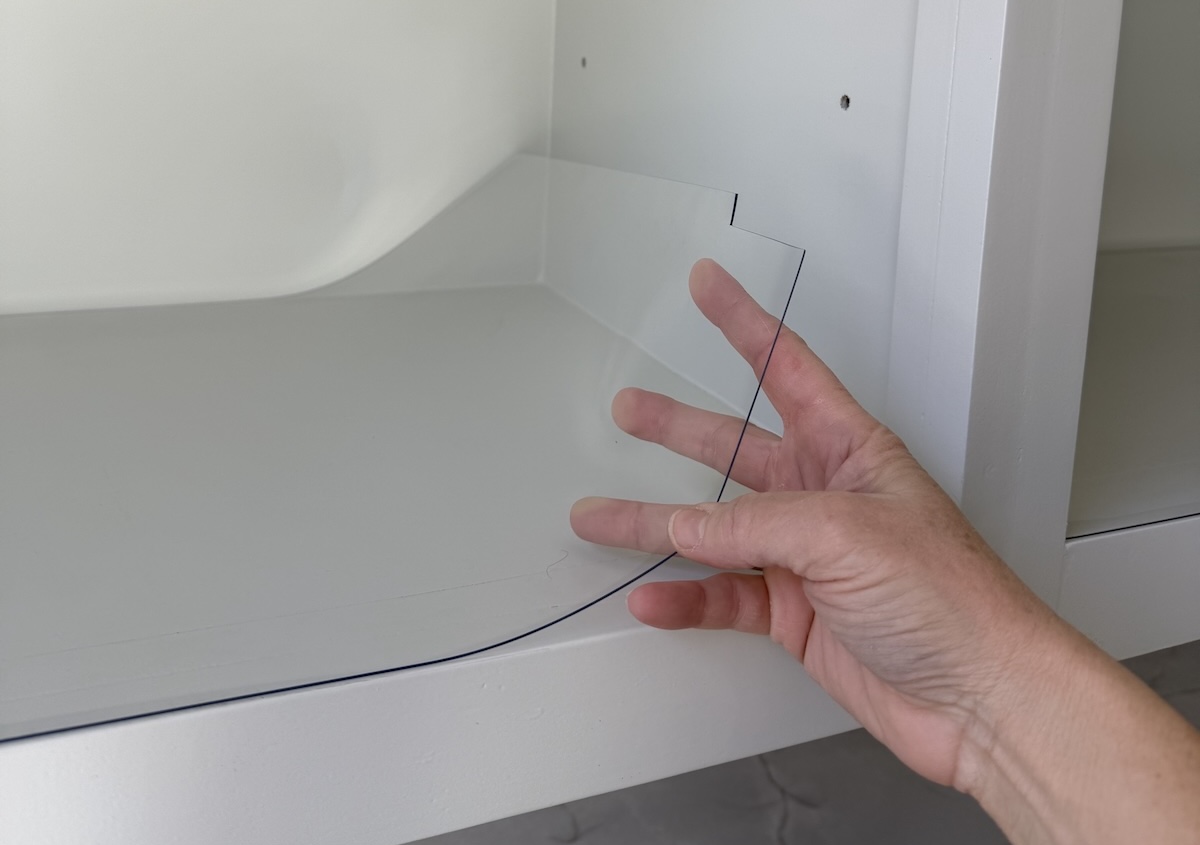
Lux Lining cuts custom clear-vinyl liners for drawers, shelves, and pantries — hundreds of odd sizes per home, each with rounded corners and notches. We built the system that turns a room’s worth of measurements into CNC-ready cut files, labels, and a packing plan in a single pass.
A single kitchen can mean two hundred liners, no two the same size, each with a corner radius and the occasional notch for a hinge or bracket. The machine could cut them — but someone had to lay out every piece and hand-write the G-code first. That was slow, wasted material, and one wrong number quietly turned into a scrapped sheet.
Off-the-shelf CNC and nesting software could cut vinyl — but the licenses cost more than the machine, and none of it knew anything about drawers, rooms, or how Lux Lining actually quotes and packs a job.
So we generate the G-code ourselves and drive an inexpensive drag-knife plotter directly. That choice shaped everything downstream: the software compensates for the blade’s 1/8″ pivot offset, cuts notches in two clean passes so their corners stay sharp, and nests every piece to spare vinyl — capability that would otherwise be locked inside someone else’s tool.
One spreadsheet becomes cut files, labels, a room visualization, and an invoice — the file-building step that used to eat the day now happens on upload.
Every home is a project — box count and square footage at a glance, so a full pantry or a single drawer is one click away.
Upload a spreadsheet of drawer measurements — fractions, mixed numbers, and inch marks all parse — and the app builds the project, grouping every piece by room. Bad rows get skipped with a warning instead of silently becoming zeros.
Every piece is bin-packed onto vinyl sheets to waste as little material as possible, with a separate algorithm for narrow ribbed stock where the ribs all have to run the same direction.
G-code is generated per sheet with drag-knife offset compensation and a two-pass notch routine — so rounded corners stay round and notch corners stay sharp on a machine that only pulls a trailing blade.
Layout PDFs, Avery labels, a room-by-room visualization, estimates, and invoices all come out of the same upload — plus a public marketing site and a Lux Partner Network for organizers and designers to resell the service.
“I used to build every cut file by hand, one coordinate at a time. Now I upload the measurements and the files come out ready to cut — no typos, no wasted sheets.”